
Rounds, Experiments and Generations#
In order to correctly interpret the results and behavior of GADemo, it is essential to understand the three hierarchical concepts that structure the execution of the algorithm: Rounds, Experiments, and Generations. Each term defines a different level of abstraction and computational repetition, as explained below.
Understanding the Hierarchy#
Round A round refers to a single user-triggered execution of GADemo — that is, each time the Run button is pressed, a new round is initiated. Each round independently performs a set of experiments based on the user-defined parameters.
Experiment An experiment represents a complete execution of the genetic algorithm using a fixed configuration: number of generations, population size, crossover and mutation rates, and the selected objective function. Multiple experiments are executed within a round, typically to assess variability and ensure statistical robustness through parallel runs.
Generation A generation corresponds to one iteration of evolution within an experiment. In each generation, a new population is produced from the previous one through selection, crossover, and mutation operations. The number of generations defines how long each experiment evolves.
Population Within each generation, the population is the set of individuals (candidate solutions) currently being evaluated and evolved. The size of this population is determined by the Population Size parameter set by the user.
Summary Table#
Concept |
Scope |
Description |
|---|---|---|
Round |
Entire execution |
One click on “Run”; triggers all configured experiments |
Experiment |
Per round |
A full GA execution from generation 0 to N |
Generation |
Per experiment |
A single iteration of evolution |
Population |
Per generation |
Set of individuals evaluated in the generation |
Visual Representation#
To better illustrate this hierarchical structure:
Round
├── Experiment 1
│   ├── Generation 1
│   ├── Generation 2
│   └── ...
├── Experiment 2
│   ├── Generation 1
│   └── ...
└── ...
Each level nests the next, emphasizing that a single round can generate multiple experiments, each of which evolves over multiple generations, with populations evaluated in every generation.
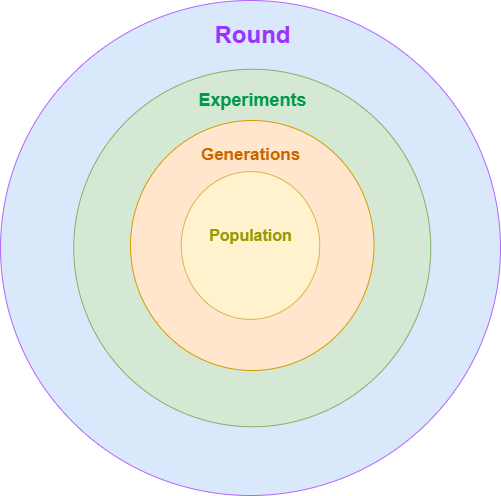
For instance, suppose the user configures:
Number of Experiments = 2
Number of Generations = 2
Population Size = 3
This implies that:
Each experiment will evolve over 2 generations,
In each generation, a population of 3 individuals is evaluated,
Therefore, one experiment performs 2 × 3 = 6 evaluations,
Across 2 experiments: 2 × 6 = 12 evaluations in total per round.
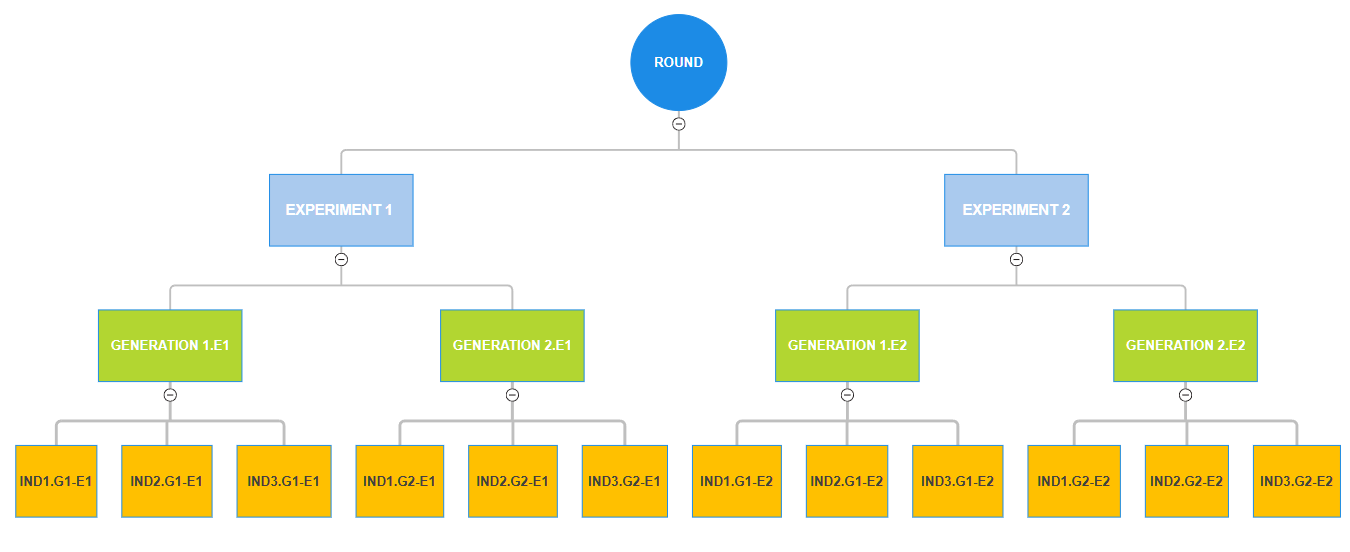
This numerical breakdown helps quantify the computational workload of a single run.
Understanding this structure is fundamental for correctly interpreting the outputs, visualizations, and comparative performance data generated by GADemo.